
Project I.G.I. - Why a Forgotten 2000 Stealth Shooter Defined a Generation
November 2, 2026
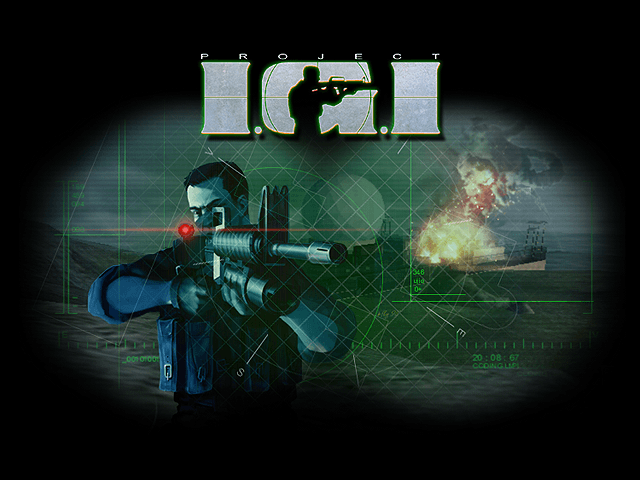
If you grew up anywhere across South Asia, the Middle East, Eastern Europe, or Vietnam in the early 2000s, you do not even need to see a screenshot. All it takes is a sound.
The cold, pulsing electronic synth of the main menu theme. The metallic hum of a freight elevator descending into an underground bunker. The sharp, echoing crack of a Dragunov sniper rifle across a snowy valley. Or the sound that still triggers an instant spike of childhood panic decades later: the wailing red base alarm siren.
For millions of players, Project I.G.I. (I'm Going In) was not just another PC game. Released in December 2000, it was a rite of passage. It was the game that introduced an entire generation to first-person shooters, stealth, map reading, and tactical patience.
Yet if you look back at Western gaming magazines from the year 2000, Project I.G.I. was treated as an average, somewhat flawed release. How did a game made by fewer than 25 people in Oslo, Norway become one of the most beloved PC classics on the planet?
It Ran on Almost Anything
Between 2000 and 2005, home computers were finally becoming common in middle-class households and neighborhood cyber cafes. Most of these machines were modest budget PCs: Pentium IIIs or early Pentium 4s with basic integrated graphics that choked on demanding Western shooters.
Project I.G.I. was built differently. Its developer, Innerloop Studios, was a small Norwegian studio founded in 1996 that had previously created the flight simulator Joint Strike Fighter. Instead of licensing a heavy indoor corridor engine like Quake III or Unreal, Innerloop adapted their flight-simulator terrain engine for a ground-level shooter.
The result was a technical marvel for the time: vast, sprawling outdoor landscapes that somehow ran smoothly on almost anything. While heavier PC games stuttered like slideshows, Project I.G.I. delivered miles of snow-covered mountains, radar stations, watchtowers, and military compounds on modest hardware. For countless kids, it was the first real 3D tactical shooter their computer could actually run.
Cyber-Cafe and Shared-PC Culture
In the early 2000s, PC gaming in these regions was rarely a solitary hobby. Home internet connections were slow dial-up or nonexistent, and online multiplayer servers were a distant luxury.
Project I.G.I. was single-player, needed no internet connection, and had a compact install size that fit onto a single CD passed from friend to friend at school.
Because one computer was often shared among an entire family or a group of neighborhood friends, playing Project I.G.I. became a social ritual. Everyone who grew up in that era remembers the scene: four or five cousins, siblings, or classmates crowded around a single glowing CRT monitor after school. One person controlled the keyboard and mouse while everyone else acted as spotters, pointing at sniper glints on distant watchtowers, warning about sweeping CCTV cameras, and arguing over whether to climb the watchtower ladder or cut through the electrified fence.
When you died, you passed the mouse to the next person.
The Proto-Far Cry "I'm Going In" Fantasy
Most shooters of the late 1990s and early 2000s trapped you in dark hallways and asked you to shoot everything that moved. Project I.G.I. gave you a pair of binoculars, a suppressed MP5SD, and a snowy hillside overlooking a fortified military base.
Years before Far Cry popularized the open-approach outpost formula, Project I.G.I. made you feel like a genuine covert operative. Stepping into the boots of former SAS agent David Llewelyn Jones, guided over radio by his handler Anya, you had to think before pulling the trigger:
- Scouting vast, sparse, almost liminal Russian and Estonian compounds through high-powered binoculars.
- Pulling up Anya's live green satellite map PDA to track roving guard patrols and tank routes.
- Shooting out security cameras or sneaking into control rooms to hack the CCTV computers.
- Climbing chain-link fences, scaling tall watchtower ladders, and sliding down steel ziplines with that unmistakable third-person camera transition.
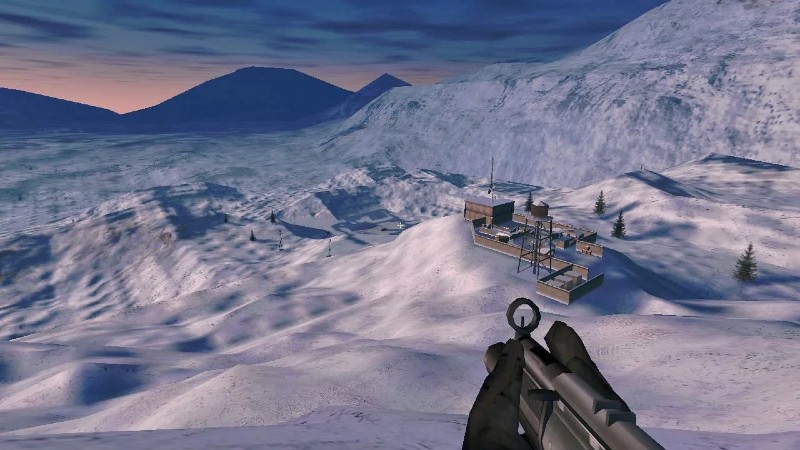
There was an eerie, quiet tension to those levels. The crunch of boots in the snow, the vast empty spaces between industrial hangars, and the knowledge that a single sniper in a watchtower was watching the courtyard gave the game an atmosphere that stuck with players for life.
Brutal Difficulty and Zero Mid-Mission Saves
Perhaps the biggest reason Project I.G.I. burned itself into collective memory was its unforgiving design: there were no mid-mission saves and no checkpoints.
If you spent 40 minutes carefully clearing a sprawling missile train yard, only to step in front of a camera, trigger the base alarm, get swarmed by infinitely spawning guards, or catch a lucky AI bullet through a wall in the final room, you went right back to the very beginning of the mission.
Western reviewers disliked this mechanic. But for kids playing in homes and cyber cafes with limited game libraries, that brutal frustration-and-reward loop turned every level into a high-stakes test. Memorizing the exact guard positions, discovering where the hidden Dragunov SVD or LAW 80 rocket launcher was stashed, and finally reaching the extraction helicopter with a sliver of health felt like a genuine achievement.
Why It Became So Hard to Play Today
Despite defining an entire era of PC gaming, Project I.G.I. practically vanished from the modern gaming landscape.
Innerloop Studios, which never grew beyond 15 to 25 people, struggled to secure funding for new projects after releasing I.G.I. 2 and permanently closed its doors in June 2003. Over the years, the original 2000 game was left behind as abandonware.
Even worse, trying to run the original 2000 DirectX 7 executable on a modern Windows 10 or Windows 11 PC is a nightmare. Without hunting down old archival ISOs and manually patching it with third-party DirectX wrappers, the menus freeze, textures flicker, or the framerate drops to a crawl. For anyone on a Mac, Chromebook, or mobile phone, playing it was out of the question altogether.
Preserved in Your Browser on Quenq
A classic that shaped the childhood of millions should not be locked behind broken Windows compatibility settings or sketchy downloads.
To keep this piece of gaming history alive, we have preserved the complete original Project I.G.I. (I'm Going In) directly on Quenq. Recompiled to modern WebAssembly, the entire 14-mission campaign runs natively inside your web browser with zero downloads, plugins, or setup required.
This preservation build keeps the 2000 original completely intact while making it effortless to play on modern hardware:
- Play on PC or Mobile: Alongside both Modern (WASD) and Original 2000 keyboard layouts, the web port features a full Mobile and Tablet Touch HUD with a virtual thumbstick, dual fire buttons, one-tap scope zoom, and Gyroscope aiming so you can line up Dragunov sniper shots by tilting your phone.
- True 16:9 Widescreen: Switch anytime between an expanded widescreen 3D field of view and the classic 4:3 aspect ratio.
- 100% Mission Unlocker: Whether you want to beat the campaign from Mission 1 or use the launcher's UNLOCK: ALL MISSIONS (100%) button to jump straight back into that one base you and your cousins could never clear in 2003, every level is ready to play.
Put on your headphones, let Kim M. Jensen's menu theme play for a moment, grab your binoculars, and head back in.